Negotiating Trade Liberalization in Argentina and Chile: When Policy Creates Politics by Andrea C Bianculli
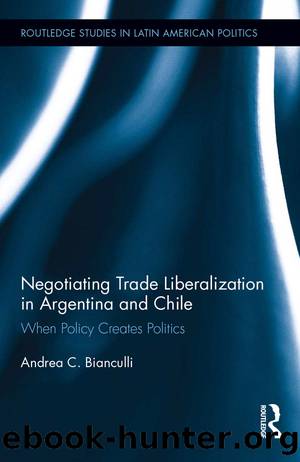
Author:Andrea C Bianculli [Bianculli, Andrea C]
Language: eng
Format: epub
Tags: International Relations, Trade & Tariffs, Public Policy, Political Science, Economic Policy, General
ISBN: 9781317363354
Google: gC0lDwAAQBAJ
Goodreads: 33341786
Publisher: Routledge
Published: 2016-12-08T00:00:00+00:00
Multilateral Trade Negotiations under the WTO
Unilateral trade liberalization was already completed before the conclusion of the UR. Hence, WTO commitments did not affect tariffs, which were at about 35 per cent. Rather, they locked in previous reforms. Moreover, multilateral undertakings entailed new commitments. They included the reform of intellectual property laws according to the Agreement on the Trade Related Aspects of Intellectual Property Rights (TRIPs), and this directly impinged on services, investments, government procurement, among other matters. In addition measures incompatible with the Trade-Related Investment Measures (TRIMs) were eliminated and subsidies reduced. Together with the legal formalization of the trade regime through the WTO dispute settlement mechanism, these changes put strong pressure on decision making. In addition, at this time of active regionalism, the new multilateral trade regime entailed an important shift in the countryâs priorities and guidelines regarding the WTO.
The WTO Agreement on Agriculture mandated a new round of multilateral negotiations to be launched in Seattle in November 1999, but the delegations failed to reach consensus on the agenda. Massive street protests led to the negotiations being postponed until the following Ministerial Conference two years later. The EU recommended that this should be called the âDoha Development Roundâ to emphasize the leading role of less developed countries in these talks, which were designed to put development and poverty reduction at the centre. Although they were initially intended to be completed by 31 December 2004, negotiations remain stalled because of marked divergences across global South and global North countries and major obstacles about farming trade liberalization.
The end of the UR and more prominently the commitment to reopen negotiations on agriculture introduced important transformations within the public sector and its relationship with the private world, which deepened in the aftermath of the failure of the III Ministerial Conference in Seattle and after the launch of the Doha Round.
First, the acceptance of WTO conflict resolution procedures led to the creation of a quasi-independent body: the National Commission of Foreign Trade (CNCE). Under the aegis of the Ministry of Economy, the CNCE was responsible for handling business petitions for trade relief against unfair foreign practices affecting the domestic market. Even if technically independent, the Ministry of Economy was responsible for appointing the CNCE board, which left the agency often subject to pressure, power and politics. The CNCE also established a rather fluid relation with the private sector. Besides responding to industrialistsâ requirements regarding protectionist measures, it provided technical assistance on international trade policy.
Second, in 2002, as the multipolar trade strategy was taking off, Argentina became enthusiastically involved in the Doha Round.16 During the UR, Argentinaâs participation was aimed at consolidating domestic economic reforms and the Ministry of Economy was thus mainly responsible (Bouzas and Soltz 2002). In contrast, the countryâs strategy was now based on diversified and reciprocal criteria. Moreover, the Marrakesh WTO agreement included a commitment to reopen services and agricultural negotiations to improve market access and reduce trade-distorting subsidies. In 2001, these issues became part of the Doha agenda. Public agricultural
Download
This site does not store any files on its server. We only index and link to content provided by other sites. Please contact the content providers to delete copyright contents if any and email us, we'll remove relevant links or contents immediately.
| Arms Control | Diplomacy |
| Security | Trades & Tariffs |
| Treaties | African |
| Asian | Australian & Oceanian |
| Canadian | Caribbean & Latin American |
| European | Middle Eastern |
| Russian & Former Soviet Union |
The Secret History by Donna Tartt(19092)
The Social Justice Warrior Handbook by Lisa De Pasquale(12191)
Thirteen Reasons Why by Jay Asher(8912)
This Is How You Lose Her by Junot Diaz(6889)
Weapons of Math Destruction by Cathy O'Neil(6281)
Zero to One by Peter Thiel(5802)
Beartown by Fredrik Backman(5759)
The Myth of the Strong Leader by Archie Brown(5509)
The Fire Next Time by James Baldwin(5449)
How Democracies Die by Steven Levitsky & Daniel Ziblatt(5219)
Promise Me, Dad by Joe Biden(5154)
Stone's Rules by Roger Stone(5088)
A Higher Loyalty: Truth, Lies, and Leadership by James Comey(4964)
100 Deadly Skills by Clint Emerson(4927)
Rise and Kill First by Ronen Bergman(4790)
Secrecy World by Jake Bernstein(4753)
The David Icke Guide to the Global Conspiracy (and how to end it) by David Icke(4720)
The Farm by Tom Rob Smith(4514)
The Doomsday Machine by Daniel Ellsberg(4490)
